CDM 353
Natural History
Please allow time for documents to load in, this may take a few seconds
1.1) Generate concepts for a wildlife short
Analysis of wildlife clips
Elephant Twins Escape Battling Bulls
The story behind this clip is focussed on a herd of elephants living on the plains. Normally, the herd would live peacefully but this natural history piece features a female elephant in oestrus ( four days where she is ready to mate). As this only happens once every four years, the normally placid males battle each other to be the one to mate with the female. In the process, the males put her twin calves at risk.
This is an example of a classic story arc where the elephants are introduced and we are given general facts about elephants during their time in oestrus. Cinematic shots in slow motion as well as thunderous music gives a powerful tone to the film. It is important to show how powerful the elephants can be before showing them battling to add intensity to the scene. Next, the story becomes more personal because the script starts to focus on the female of the herd and gives her human-like qualities. By describing her as a mother of two twins, we are pushed to feel empathy toward the elephant as protecting the young is a universal experience. The climax begins shortly after, where the audience sees the extent of aggression that the bulls have against one another when fighting over the female. We are shocked by the violence from elephants which we would normally see as gentle animals. As the camera is focussed on the twins, we are made to feel scared for their safety as we see them struggle to keep up with their mother. There are points where we see the twins get hit and so we think that they might not be able to get away from the violence but after a while the mother and calves escape. This is the anticlimax of the story, as the elephants manage to get away and the music deescalates. At the end we reach a resolution because the elephants are out of danger and the female mates with a male which stops the fighting.
Exhausted Lion Cubs Battle to Survive
This clip features a pride of lions in search of prey to hunt in order to feed their families. Unfortunately, it is a long journey to their next hunting ground and not all of the lion cubs can keep up with the lionesses. Before long, the weakest cub is left behind to fend for itself, leaving the audience with nothing but sadness for the helpless animal.
There is a classic story structure used here as well as anthropomorphism which aims to connect the audience to the pride and side with the lions over the prey that they are hunting.
By using the lion's point of view and narrating the struggles that they face, we feel bad for them and want to see their starvation cured. Humans recognise the hunger that the lions feel. At the beginning, there isn’t any music at all, this pulls the audience closer to the action and adds a sense of realism to the film. As well as this, it draws our attention to the narrator’s words while he describes the poor situation of the lion cub and immerses us in the harsh reality of the cub’s life. When we can see and hear from the lion’s point of view the audience can empathise with the lion cub easily.
A really effective shot is used just over a minute into the natural history piece. After the narrator explains that the cub is no longer strong enough to keep up with the mile long trek to the next hunting ground, the camera shows an extreme wide shot with nothing but the cub in the centre. This single shot only lasts a few seconds but it is very impactful in isolating the cub and showing that there is nothing around to save it from dying of starvation. This emotive shot aims to tell the brutal reality of life on the plains. The narrator has to remain impartial and let nature take its course so he moves on to explain how the rest of the pride survive, by hunting. Fast-paced music starts to play as the cameras track the lions stalking their prey ready to pounce. Rather than saying that the warthog's life depends on if the lions can catch it, the narrator says that the cubs life depends on if they can catch the warthog. As we have been following the lives of the cubs we want them to succeed and catch the prey instead of letting the prey get away. Normally, this would be the end of a classic story arc as we have reached a resolution, however the story refers back to the starved lion cub from earlier. In doing this we feel a conflict between the success of the rest of the pride and the misfortune of the lion that was left behind. Especially now because we know that if the cub had hung on for slightly longer he would have survived.
Hippos take on crocodiles for best sunbathing spot
To begin with, lots of panning shots across both groups of animals are used to give a standoffish effect between them and build a problem. They are almost used as establishing shots because we realise that they are against each other.
This piece doesn't follow a strict story arc, it does have a problem, action and resolution but not in a traditional way. The problem is as the name suggests. A group of crocodiles have taken over the banks of the river that they share with the hippos. In this case one particular hippo is presented as brave and comical.
We follow the story of one hippo that breaks from the group with her calves closely following. She continues to waddle over to the crocodiles and completely ignore the fact that they could be dangerous. Crocodiles are used to being feared, as stated by the narrator so they are taken by surprise by the display of courage. The chirpy music along with the camera angle of the hippo right in the crocodile's face seems silly and makes the crocodiles look like less of a threat. The crocs become even less intimidating when even the young calves are able to push them off the banks by sitting on them or nibbling at their tails. The actions are presented as ridiculous and we enjoy the ordeal because the crocodiles are made to look small and passive to the attacks. People like to root for the weaker animal and see them win so at the end of it all, the narrator declares the hippos victorious.
My Natural History Short Film Story Synopsis
We were tasked with generating a concept for a natural history film that required accurate and detailed research into the subject. I needed to demonstrate an understanding of the subject to be filmed, which in our case was a Preying Mantis. As well as where it lives, how it lives and what behaviour we can expect to see in the film. Please see my idea for the Preying Mantis story below.
Introducing our praying mantis shown in its natural habitat, the forests of Southeast asia. In order for the mantis to survive in the dense wilderness, it must be well-adapted to its surroundings. It is a harsh world but the praying mantis must be harsher. The mantis is the only insect in the world that can rotate its head almost 180 degrees, making it impossible to evade its gaze. With his five eyes he watches, and waits for the perfect moment to strike, until… He returns to the prayer-like position that gives the insect his name. Another successful day of survival for the stealthy bug.
Concepts for different platforms
Our second task was to individually come up with an idea for a Platform and Format for the film this could be for Youtube, TikTok or Instagram. For example, a 3-5 minute film for Youtube and Vimeo or it might be a series of shorts for release on TikTok/YouTube Shorts. Please see my concepts for both Youtube and Tik Tok below.
Concept 1 (Youtube Video)
A 3-5 minute natural history short about a day in the life of a praying mantis and how it survives in its natural habitat. Cinematic establishing shots showing time of day across the forest floor will be used to introduce our subject and while facts are given about how it blends in so well. Due to the length of the film it will feature moments of calm in contrast to the aggressive attacks to give the audience a break from the action. The mantis is presented as a ‘calm killer’ while the script provides the audience with facts about the adaptations which make it stand out from the rest. After the mantis has made its kill the film ends with a sunset and the picture fades to darkness.
Concept 2 (Tik Tok Series)
A series of 30 second tik tok videos that are fast, snappy and fun for a younger audience. The videos will contain fast-paced subtitles and countdown clocks to keep the audience hooked. The videos will start with split screen recording of the VO in the bottom half of the screen and mantis footage in the top half. Part way through the video will switch to completely mantis video as it makes a kill or exhibits interesting behaviours. Entertaining/dramatic music is really important to keep the audience engaged.
Mantis Pitch (Audio Only)
The pitch to my tutor about my two concepts for the natural history short film.
1.2) Pre-shooting script
Pre-shooting script

Final script
Storyboard


Risk Assessment


1.3) Implement the production plan
Behind the scenes
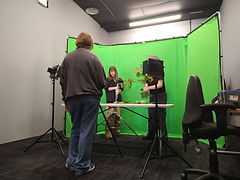
The set-up for the mantis documentary was quite simple which made managing the quality of the shots easy. However, in my opinion the finished result could have been improved by using multiple cameras and shooting at two different angles at once. We shot with a single camera, although we switched between a camera with a macro lens and a standard zoom lens on the camera throughout the day, as there weren’t enough cameras to allow for multiple angles at once. As you can see from the behind the scenes photos, the basic setup was a camera on a tripod, set in front of a table covered with green paper to blend in with the foreground and create a backdrop. We took leaves and branches and clamped them to a large metal stand to suspend them in the air as if they were the branches of a real tree. We then placed our subject between the leaves and blurred the background keeping the focus on the mantis. The shine of the metallic stand did reflect on the camera a few times, however this was easily fixtable by adjusting the position of the stand to be off-camera. Interestingly, when we placed the mantis in the set, it was most drawn towards the studio lights.


As we used three lights to light up the set, we were concerned at the beginning that they would be too bright for the mantis to stand and therefore overwhelm the animal. However, to our surprise the mantis was drawn to the brightest light which was set at the very end of the branch so it decided to walk towards it, making for some brilliant action shots of the mantis moving. We improvised by changing the brightness and colour temperature of the lights on set to see how the mantis would react. We discovered that the mantis preferred bright warm light and assumed that this was because it reflected sunlight the most. I used the walking shots later on in the edit to show the mantis pursuing its prey and to quicken the pace of the documentary. Another way that the mantis surprised us was the way that it would periodically turn its head away from the camera to look the opposite direction. This surprised us because in practice, the mantis seemed interested in the camera and was very interactive with its surroundings. Despite this, we did see it really come to life during the kill shot as its natural instincts seemed to kick in, allowing us to get the most realistic hunting action that we could in a staged environment.
We decided to film the insect in captivity because filming in the wild can be dangerous to both the crew and the animal, as the environment is not controllable by humans. If we film in captivity, we can remove the worry about other stimuli/ other predators interfering with the animal’s behaviour that we are studying and we are able to focus on the animal with less difficulty. Furthermore, a controlled environment means that crew can initiate or prompt some of the animal’s stand out behaviours like its feeding routine or sleep cycle because we can simulate or control its proximity to food, heat and light. Of course there are laws concerning how animals are treated in captivity, however considering that mantids are invertebrates, they are not protected by The Animal Welfare Act, The Dangerous Wild Animals Act or similar laws and are not part of CITES (CONVENTION IN INTERNATIONAL TRADE IN ENDANGERED SPECIES). So these factors make caring for the mantis during filming less worrying although from a moral standpoint the insect should still be treated with care and respect.


Because we didn’t shoot in the mantis’ natural habitat, the plants that we used were obviously not native to Southeast Asia either. It is important to write that the mantis was filmed in captivity in the credits, to build a level of trust with the audience and also to give reason as to why the plant species are different from what you would expect to find in Asia.

Description of Workflow & Editing Process
The Mantis: A Day In The Life Documentary
After editing the documentary for quite some time, both myself and others thought that the original AI narration did not have enough energy or passion behind it to keep the viewers engaged. For this reason, I decided to replace the narration with my own voice. This way, I could change the tone, speed and pitch of my voice to suit my short nature documentary better. However, I have added the original 'David Attenborough' recording below so that you can listen to the initial voice over.