CDM 354
Short Film Production (Fiction)
1.1
Narratives In Film
arrative is a term used loosely to describe almost every form of story telling. So naturally narratives appear in the making of film. But what exactly is a narrative?
What exactly is a narrative?
-
Films and TV shows
-
Novels and plays
-
Graphic novels and comic books
-
Video games
-
Journalism and essays
-
History accounts
-
Biographies and memoirs
-
Myths and legends
-
Religious texts
-
Podcasts
-
Stories around the campfire
Narrative Structure

The beginning


The inciting incident
Climax
Falling Action


-
Follows a circular narrative as the film starts and ends in the same diner with the same characters.
-
Pulp Fiction is an anthology film, so individual stories relating to each other featuring individual characters engaged in an overall bigger story.
-
Tarantino tries to avoid confusion of timeline by using props and dialogue e.g “I never thanked you for dinner” .
-
Perspective is the key to the affect of the narrative on the audience. At the beginning of the film Honey Bunny, when robbing the diner says she will “execute every single m*therf*ucking one of” the customers; however, later at end of the film in what is the continued scene from the beginning, Honey Bunny says she’s “execute all of you m*therf*uckers” the slight variation in speech highlights the importance of perspective. In the scene at the beginning we are viewing the robbery in the perceptive of Honey Bunny and Pumpkin and they are presented to us as violent threatening criminals, the scene at the end switches to the narrative of Jules and Vincent who are then presented as the real criminals whilst Honey Bunny and Pumpkin appear weak and inferior.
-
Pulp Fiction features several character types from American culture such as the gangster (Marcellus), the noble boxer (Butch who refuses to throw his fight), the gangster’s wife (Mia), the hitmen (Vincent and Jules) and the fixer (Wolf). These characters were popularised in classic Hollywood films between 1930 and 1960 made within the Hollywood Studio System. However, these films were told in chronological linear order whereas Tarantino submerses film.
The beginning
The inciting incident
Climax
Falling Action

Character Development & Story Arcs
tory arcs are shaped by rising and falling emotion and tension, and character development. When these elements are combined effectively, you have a powerful
What exactly is character development?
-
Rags to riches (rise).
-
Tragedy, or Riches to rags (fall).
-
Man in a hole (fall-rise).
-
Icarus (rise-fall).
-
Cinderella (rise-fall-rise).
-
Oedipus (fall-rise-fall).

Examples of character development in film
Lance Corporal Schofield (1917)
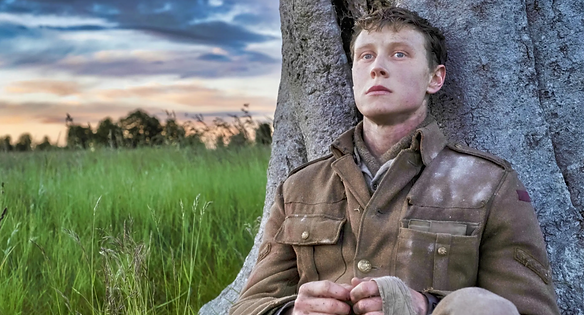
Schofield is in the 8th battalion (up to about 1,000 soldiers) and he has a brother also in the army who is in the second division
Backstory
Will Schofield was born in 1890. At a young age he married an unknown woman and had two daughters. In the summer of 1916, Schofield joined the British Army during World War I and took part of the battle of the Somme before he was reassigned to the 8th Battalion, East Surrey Regiment, where he befriended Tom Blake and rose to the rank of Lance Corporal. Schofield earned a medal for his bravery at the the Somme, causing Blake to want a medal for himself. In April 6, 1917, General John Erinmore summoned Blake for a special assignment, and Blake selected Schofield as his companion, anticipating an easy job such as fetching food from another part of the trench.


Personal Horror Idea
Mindmap

Log line & Working Title
"Seeing Double"
Log line
The working title I have chosen is “seeing double”. I have chosen this because my film is centred around a character who meets their Doppelganger - or at least believes that they have. As suggested in its name, the film also has a second meaning behind it.
The phrase “seeing double” refers to a condition of the eyes called Diplopia. Diplopia is a vision alteration consisting in the perception of double vision. The condition can affect both eyes (binocular) or one eye (monocular). This vision disturbance can be horizontal, vertical or oblique depending on how the images appear (to the side, above or diagonal to the object). Hallucinations, as well as double vision can be symptoms of schizophrenia. Although the title is contradictory to the theme of isolation, I have far from ignored that in my film as the character is actually completely alone in their own home.
When a young person falls asleep and forgets to take their meds, their mind is forced into believing that there is an evil version of themselves stalking their every move which they swap bodies with on contact.

Synopsis of personal horror film idea
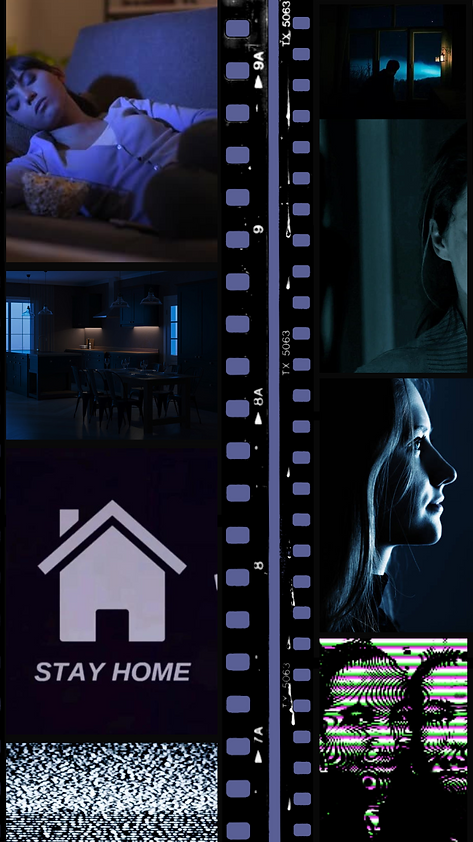
ACT 1 SCENE SETUP
Sol Knightley has recently moved out of his parent’s house to become more independent. But having only recently started living alone, they are not very self-sufficient at taking their meds on time. Focus on the pillbox on top of the microwave. One night, they fall asleep on the sofa in front of the television while watching a horror movie. As they sleep, a voice starts reading a recorded message on the TV in front of them. It is an international warning instructing the public to stay inside and lock all windows and doors as the police were receiving a large number of calls about murderous look-alikes who tended to smile at their victims before taking their lives. Sol wakes up and turns off the TV with the remote, after writing the message off as the end of the horror movie which they slept through.
ACT 2 REALISING A PROBLEM
Standing up now, they walk into the kitchen to wash out a mug. While washing up, through the large window/conservatory the floodlight suddenly turns on outside illuminating the kitchen briefly. They are intrigued and look out the window. When the light turns off, Sol focuses their attention back on the washing up. The motion sensor for the light is activated once more and the light turns on again. This time, a sheet on the washing line that is blowing in the wind comes off of the line and sticks to the outline of a figure which quickly disappears. There is a glance at the rest of the garden as the light snaps off again. Convinced that they saw something strange in the garden this time, Sol grabs a knife frantically from the draining board and presses their face to the glass of the window. After a moment, the light comes on one more time and seemingly the coast is clear, only the reflection of Sol’s face in the glass.
ACT 3 RUNNING FROM THE PROBLEM
Suddenly, the doppelganger lashes at the window and the character screams and stumbles back. The light turns off and the character runs through dark hallways and up the stairs to their dimly lit bedroom with the weapon still in their hand. They slam the door and pull the curtains closed. Pacing up and down their bedroom, they remember the words they’d heard in the recording previously. Sol runs to the bedside table and slams the knife down so that they can properly rummage through the drawer to find the remote. They power on the TV only to show the warning message they saw before. They watch the recorded message halfway through when the TV suddenly becomes glitchy and displays static. It’s as if the audio is corrupted. The only light that you can see is from the static TV which envelops Sol’s figure, silhouetting them against the darkness of the bedroom. The static becomes louder and louder until they have to cover their ears to stop the noise from tearing their mind apart. After many attempts at turning the TV off with the remote, Sol switches the TV off at the wall but the TV remains switched on. Frustrated, they keep flipping the switch until the TV starts playing the message again repeatedly saying "exercise extreme caution".
Out of the extreme noise, the TV finally glitches out completely and switches off. In the black reflection of the TV screen, the smiling doppelganger towers behind them. There are intense screeching noises as the doppelganger reaches for Sol. Sol feels a firm hand on their shoulder and it cuts to black.
ACT 4 BUILDING CONTEXT & CONCLUSION
Flashback to Sol sitting on the stairs listening to their parents talking about their condition. They discuss that Sol’s condition is manageable with medication and that it was time for them to move out to become more social and independent. Flashback to the present and our character finds themself outside their house looking through a window at someone who looks like them sleeping on the sofa with the same horror movie that they were watching at the start of the film. It is as if they have swapped places with the doppelganger. Freaking out, they catch a reflection of themself in the window pane; they have even taken on the appearance of the doppelganger with a sickening smile painted across their lips. The film cuts to black.
Narrative Structure Type

Character Development
CHARACTER DEVELOPMENT & ANALYSIS
Our character in this story is currently gender-neutral as I don’t have an actor to fill the role. The most important thing is that the actor delivers a convincing performance and a realistic representation of the emotions a person would experience in a terrifying situation.
CHARACTER STORY ARC STRUCTURE
In the diagram above I’ve plotted the diagram for the character’s journey in the short film. The title is from bad to worse, although the character starts off okay and ultimately gets worse rapidly. Another name for this is a tragedy and lots of horror films follow this as a resolution is usually not found to make the film all the more uncomfortable.
Living a domestic life in the west of England and working on their mental health during their studies. Their personality is erratic and numb. Sol is a young adult, but they don’t share a common interest in teen parties or nights out. As an introvert, they prefer to spend their nights in isolation, despite their parent's disapproval. Sol is impulsive and turbulent and tends to neglect thinking things through before acting on instinct. Yet they’re also incredibly brave and empathetic if they do have a connection with someone. Though it sometimes seems like they have no compassion, they have more humanity than others realise.
Pitching Audio Recording
Define the idea you are moving forward with
The horror idea we decided to go with has the working title ‘Babysitter’. The idea was originally a crossover between my personal horror story, and Ayla’s personal horror story. Our group liked the plot of both stories so we tried to incorporate the villain from my film into Ayla’s setting.
Ayla had come up with the idea of a babysitter that goes to work at a religious couple’s house. We worked off of this idea that the babysitter would find themselves trapped by a monster in the house after the parents have left.
It was always intended that the parents knew about the monster in their “child’s” room, as they intended to feed their babysitters to it.
The villain in my story was a doppelganger/evil twin. The original idea was that when the babysitter starts to notice something strange on the monitor, she goes upstairs to find out that the baby is non-existent and she gets trapped in a room with her evil twin.
We had many group discussions which led to us dropping this idea, as we felt like it was just a fusion of two very different ideas. Although, we deliberated over these three options for our villain: demonic baby, doppelganger, demonic girl. After we had all the conversations about maintaining a theme in the film and the difficulty of realistically creating these different characters, we decided to go with the idea of a demonic baby to stick to the theme of the babysitter.
Overall, I think we were happy with the decisions we made about the storyline of our short horror film and the characters that we included.
Group Script Drafts
Group Script Draft 1

Page 1

Page 2

Page 3

Page 4
End of group script draft 1.
Group Script Draft 2

Page 1
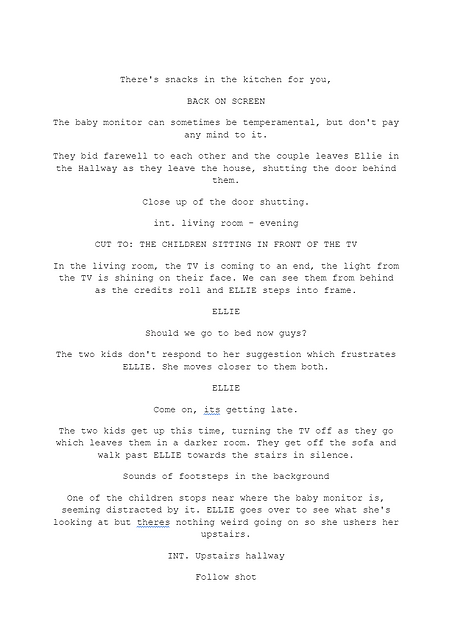
Page 2

Page 3

Page 4
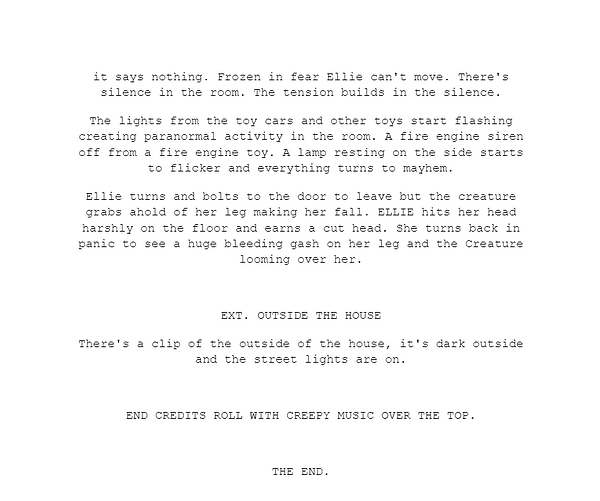
End of group script draft 2.
Written Peer Feedback
“WHAT DO YOU WANT, WHAT ARE YOU, WHO ARE YOU?’
We think this should be “what do you want, who are you, what are you?” makes more sense.
Maybe when shes watching the film she should hear a sound upstairs before looking at the baby monitor.
There could definitely be more depth added to ellies character as we dont really relate with her that much.
We like the follow shot to the bedroom, adds a nice bit of perspective. This part aslo has a nice anticlimax when there is nothing in the room.
Its not that clear whether the kids are meant to be being creepy or not. Either make them normal or give a reason for them to be so weird.
Baby is confusing us, didnt have any interactions with the baby, not a clear interaction with it.
I really like the bit with the baby monitor having creature on it but not in real life.
Also when the toys start flashing that is a nice way to build sense of panic
Good description and introduction to Ellie. We just think she needs to be a bit more relatable. Maybe build on the babysitting aspect of it as i think this is where people will relate the most. Being in someone elses house where you dont really know how things work. Maybe she could go looking for the snacks in the kitchen that the parents talked about. Sort of feels like shes very comfortable in her own home and i think theres the opportunity to build an eerie feel at that point.
All In all though there is a very nice intriguing story to it that all flows very well. I can really picture it and its clear that u have a stong idea of the story.
Something that confused us is the way there is no photos of the baby. Makes me just think they either dont have any yet because the babe is new or the babe dont exist.
I like the pitch black door that is nice i think you can do really nice things with lighting there
You make the baby seem very vulnerable and this is nice because you want ellie to protect herself but you know she has to protect the babe.
Just a suggestion but if maybe she just heard a loud noise when shes watching a film and goes up to check on the baby it kind of keeps the baby monitor thing fresh. If we see the creature on baby monitor the second time all that tension from the first time is sort of diminished. Just hearing a noise the first time saturates all the tension on the baby monitor creature the first time giving a larger climax. The noise sort of begins that steady build of fear. Either way i think the baby monitor is a really clever way to present it.
Script Final Draft
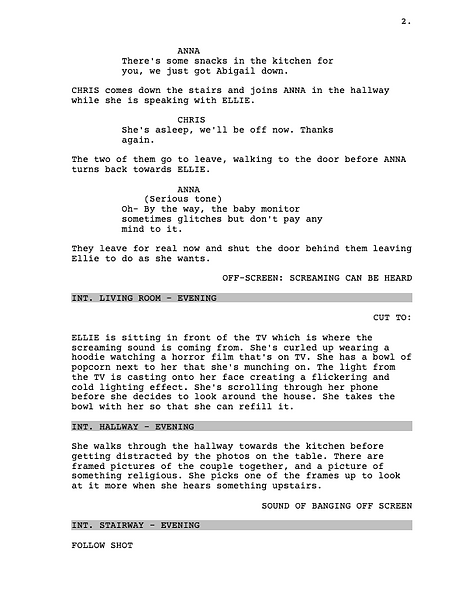
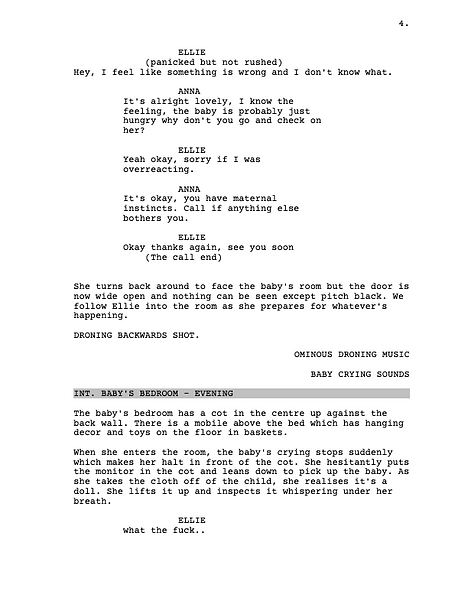
This is the final draft for the script of our short supernatural horror film titled "The Babysitter". As you can see, there are a few subtle changes between the drafts and the final script. These changes were made after receiving feedback from our tutors. In order to make our film the best it could be, they suggested that we remove the toy car crashing into the wall and the flashing of the lights in the end scene. They didn't feel like the paranormal element of the film helped to advance the story or stick to the supernatural theme that we originally chose for the film. For this reason, it was removed from the final draft and replaced with a crucifix falling from the wall on the upstairs landing. We still wanted to keep the idea of something strange luring the character upstairs, but perhaps lean away from the paranormal ideas and stick to the original religious themes. One more change that was made was to the some of the dialogue at the opening of the film, simply to make the interaction feel more genuine but that was a discussion made between the group. The very last change was the monster itself which became a large demonic baby. This was another suggestion by the tutors, because of the name "The Babysitter" they felt like we should at least have some kind of baby-like character over just a doll. There was a suggestion made by the tutors to make the list of previous babysitters more subtle. Perhaps to incorporate it on the back of a newspaper rather than directly focussing the camera on a list of crossed out babysitters. However, we decided not to change this aspect as we really thought that there was nowhere else that we could include this element comfortably in the script.



Director's Visual Treatment


1.2
Script Lining


Shot Lists
Act 1



Act 2


Act 3


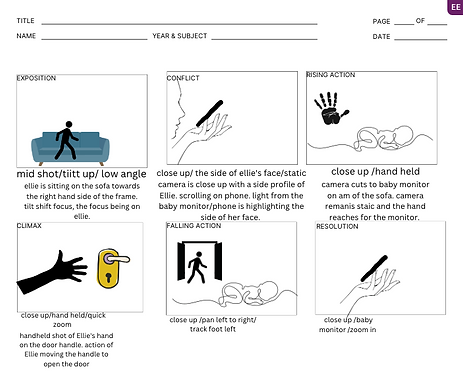
Babysitter Storyboards
Storyboards highlighted in red were submitted by myself.




Shooting Script
Day 1


Day 2


Location Recce


Risk Assessment


Production Schedule


Daily Shooting Schedule


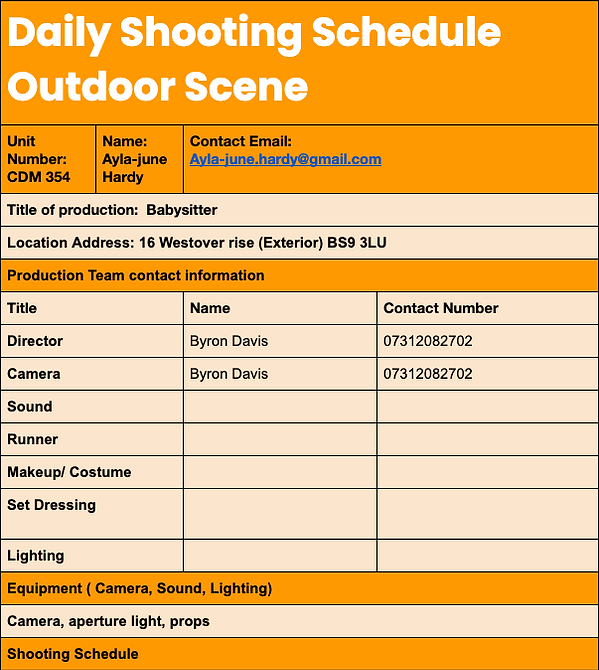

Cast & Crew Call Sheet

Model Release Forms
1.3
Ella Brooks
Jeniene Hughes
Chris Hughes
Finished Horror Film
1.4
Account of Production
Account
On the final day before shooting, we had a group meeting which was really effective in solidifying our ideas and clearing up any uncertainties about the roles assigned on set. This leads me to another aspect of pre-production planning that really helped us on the day of the shoot. Because we printed out the: lighting diagrams, makeup designs, shooting script, script, etc. we were able to show the actors/actress who was playing the parents their lines.
On day one, we had some very minor confusion over the dialogue in the opening scene where the words spoken were slightly different from what was on the script. This would have been fine, better even, because we wanted the script to feel as natural as possible. However, we had to record audio on a mobile phone to be dubbed over the top of the video when we couldn’t work the boom mic.
Even though we were unable to complete a recce before the day of the shoot, I don’t believe that this slowed us down at all. A very good quality description of the house was provided beforehand, as well as some images of problem areas like the front entrance of the house. Between these, we were able to create accurate plans of the house before arrival so this is definitely something that should continue in the future if the location is not accessible to everyone before the start of the shoot.
On day two, it was time to do the gore makeup and decorate the costume for our actresses. I felt that this went really well overall. We had to: add makeup to the baby’s dress, decorate the baby’s claws, add fresh blood to the baby's mask, and add slashes to our lead actress.
For efficiency, two members of our team spent time decorating the costume and making the mixture for the slashes. Meanwhile, scene 6 was being filmed upstairs with our lead actress, so no time was wasted.
As we had already practiced the makeup slashes several times, it was relatively quick to do on the day. The only issue we ran into was the heat. Because it was such a hot day, the makeup became much more difficult to apply than normal due to the cornflour mixture being sticky.
The baby’s mask was pre-scarred and the skin painted to match our actresses skin tone in pre-production. The only part left to do on set was to add the blood to the hands of our monster.
Going into the final shoot, we thought we had the ending figured out, but between the directors of this scene and the rest of the group, we decided we didn’t like the layout. The directors communicated the idea for the new ending really well so we ended up finishing the shoot sooner than expected and with extra shots to what we had originally planned.
The way we had decorated the room, there were hooks placed conveniently at head height of our actress all around the room so we hung some creepy toys on all the hooks and used that as a fake jumpscare instead of the original ending. Blocking every shot with the camera person before actually doing any shots in the mask was the only way to make sure that we are being safe. This way the whole crew knew what to expect when the shots for the ending were taking place.
The majority of the shots were in focus and captured at the correct fps, which is another positive that I noticed watching the footage back, as this is an issue that I have run into plenty of times before. Red guides on the camera helped us achieve this.
Evaluation of Production
Overall evaluation of production successes
Evaluation
Throughout the pre-production process, from the time the group came together for the first time, I felt as if there was always a good group dynamic. There were of course some disagreements and tension between us as there would be in most groups but I think we worked through these successfully. The most important thing that I think we did well was to voice concerns and bring the group together so that things could be sorted before the day of the shoot. One thing we could all agree on was that arguing on any set is unprofessional and it slows down the production for everyone because we cannot move on until everyone is happy. This is why we spent two weeks rewriting and editing documents like the script and having everyone pick out points that they didn’t like so that filming ran as smoothly as possible.
Sound, and making use of the boom mic was definitely an area that we could have improved on. We only had limited time with the actors and while the camera, lighting, and actors were in place, we were still waiting on the boom mic as we didn’t know how to operate it correctly. Using a mobile phone to record the audio meant that there was a decrease in the quality of the audio, even with a relatively new phone.
I feel responsible for the boom as the sound was my role in the first scene, so it was down to me to know how to set up the boom mic. Looking back on it, I should have asked for a demonstration of how to use the boom mic and how to pack it away. Not only would this have sped up set-up time, but it would have greatly improved the quality of the audio and made sure that the boom was packed away swiftly and without damaging the equipment. Unfortunately, the mic was out for a shoot the day before ours so I didn’t have the chance to familiarise myself with how it worked but I still could have done this weeks before the shoot.
On the positive side, there is only minimal dialogue in the film so syncing audio and video should be easy, according to the script. Additionally, when recording the sound, we were in a very quiet area which meant that background noise wasn’t interfering with the dialogue.
There are a few reasons why the production had a slow start on day one, not just because we couldn’t operate the boom mic. Not all crew members were on set at the correct time, so next time I’d make sure that all the crew is briefed so if they are going to be late, they would contact a crew member who would share that information with the rest of the group so that we could collectively agree on someone who could fulfil their role until they arrive on set. Another reason why we didn’t get started quickly was that we had trouble securing the blackouts around the room. Next time, we’ll use tape that is strong enough to hold the weight of the drapes over the windows, without causing damage to the wall upon removal. Ultimately, the lesson to be learned from this was that we needed to add wide tape to the kit list to make sure that the blackouts are secure.
I think splitting half the team between makeup and half on some later scenes was a good way to divide tasks in the future to make the most effective use of our time. Luckily, the dress came up high enough on the neck to disguise the joint between the mask and the rest of the neck.
We encountered an issue with our vaseline and cornflour mixture. To improve on this next time, we discovered it is much better to pre-mix the cornflour and vaseline and then refrigerate it before application.
Frustratingly, the heat caused the baby mask to become unbearable to wear for long periods of time. We learned that the rate of the shots at the end needed to be very swift, so that we were not risking the health and safety of our actress. The actress’ comfort in the mask was not a risk that we considered in pre-production because we didn’t take the hot weather into account. To add a level of professionalism to our future shoots, I think that a weather report should be added to our daily shooting schedule so that we can plan ahead for weather related problems like this.
Watching the footage back now in post-production, I realise that the lighting in the beginning 3 scenes was very effective. This is a result I’m very happy with considering we decided to deviate from the original lighting diagrams. The shadows cast onto the stairs in scene 3 are some of my favourite shots from across the entire shoot.
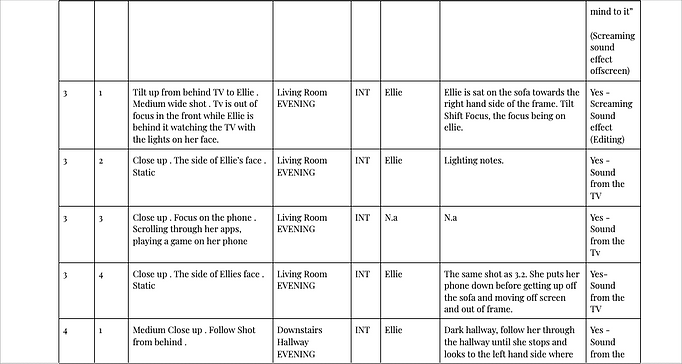
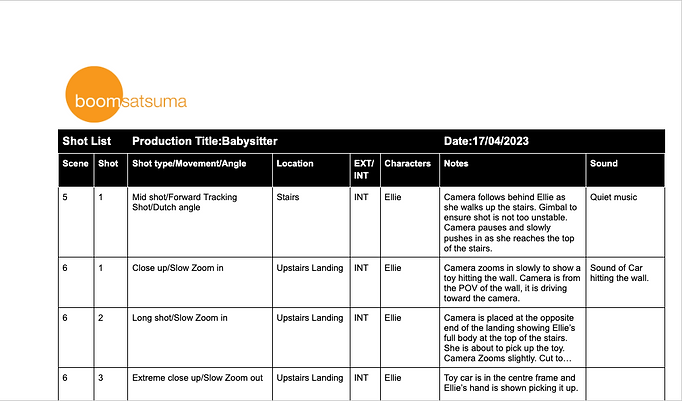
Our shot list was arranged in a confusing way, the shots were numbered incorrectly beforehand and we should have printed it in a book format like a script that can be read from front to back.
-
The audition monologue was too long which put some actors off. We did shorten this but only very close to the deadline, So in the future a shorter monologue in the first place would provide us with a more appealing role to aspiring actors/actresses.
-
Speaking of actors, something that would have been useful would be to remind auditionees of the deadline a few days before it is up to make sure that any last-minute auditions have a chance to be considered.
-
Despite some minor issues, I think the shoot went really well overall. Mainly down to the immense amount of planning that went into it.
Overall evaluation of production improvements