CDM 355
Pre-Production in Creative Digital Media
1.1
Please allow time for documents to load in, this may take a few seconds
Explanation of pre-production
1.2/3
Pre production documents
Director's Visual Treatment
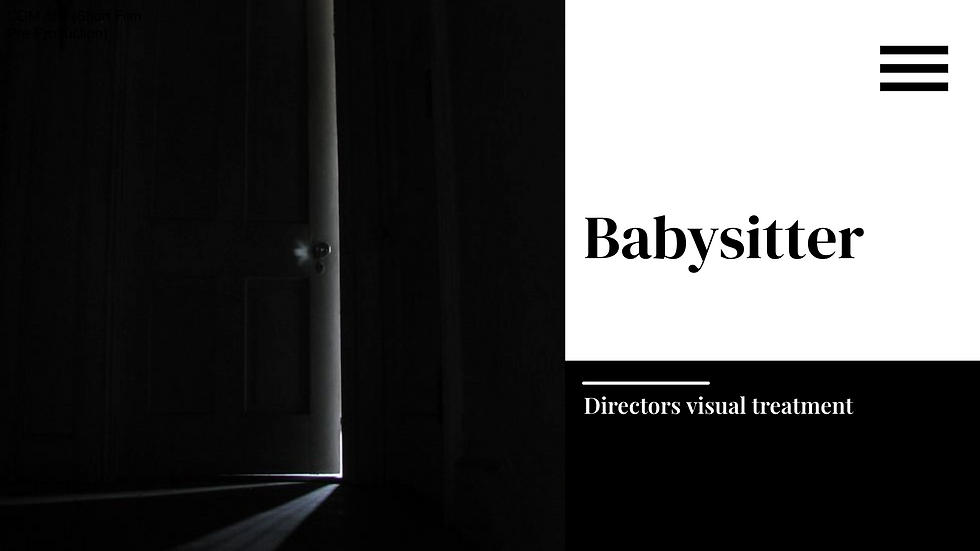


Director's Visual Treatment - Document Description
This document is called a director's visual treatment. Visual treatments are used by directors to present a film to media companies which have the potential to fund and produce the project for release. These treatments give production companies a chance to see how the director intends the final film to look visually. Conventionally, a director’s visual treatment is a compilation of existing images, descriptions and ideas put together by the director of the proposed film to pitch to potential investors and production companies. Visual treatments carry important information about the aesthetic, cinematography and overall look intended for the film. Rather than containing lengthy descriptions of the plot, script and the logistics of producing the film, treatments contain in-depth visual information companies use to decide whether or not the film proposal is worth investing in.
A successful film treatment will have convinced the investor to grant the director permission to make the film, as well as giving that director a budget to work within in order to make that film.
Film treatments are a really valuable resource in the early stages of production. Not only to investors, but also to the production team that is going to be working on the film itself. This is because the visual treatment communicates the director's vision and plays an important role in the development of future pre-production documents like the storyboards. An example to demonstrate the importance of the visual treatment would be if the director of an upcoming Sci-fi film were to ask their storyboard artist working on the film to draw 3 scenes featuring an alien. However, the problem with this is that the alien could look completely different to how the director envisioned it to look in the first place and the design is likely to veer very far off of the original intended aesthetic or look that the director pitched. Overall, a film without a visual treatment would probably result in wasted time and money as the storyboards would have to be redrawn to the director’s liking. Furthermore, even when the storyboards for the scenes are redrawn, there is still no guarantee that the new storyboards will be any closer to the intended designs for the alien. Therefore, by having a strong aesthetic to the film, (carried in a visual format) the production team is on the same page as the director as to how the final shots should look. Because of this, they are able to deliver the director's film as it was meant much more effectively than without the visual treatment.
The director’s visual treatment does not stop being useful after the early stages of production either. Cinematographers can benefit massively from a clear visual treatment. Mainly, this is down to the fact that after looking at the treatment they know the aesthetic that the director is aiming to achieve. Good cinematographers can draw upon the treatment and use it as a tool to guide them during the shoot. At the same time, they may also refer back to it should they need to as this process allows the scenes to remain consistent and fluid.
Exactly the same can be said for colourists in post-production. During the stages of post-production colourists may use the treatment to influence the way they grade the film alongside the director’s instruction. This was certainly the case for our film ‘The Babysitter’ as the director’s visual treatment ensured everyone in our group knew how the outcome of the short would look. So even though 5 final short films were produced (1 edited by each of us) every version was visually graded very similarly.
A group visual treatment gave our tutors an idea of the aesthetic we were aspiring to replicate. As you can see, our treatment is compiled of existing images that we felt were relevant to our film (the plot as well as the look) and other important visual information such as the appearance of the key locations featured in the short. This tells me that our visual treatment was effective because we all shared the same creative vision.
Although these aren't the only uses for the director’s visual treatment, I feel I have covered most of the main uses and reasons for needing the director’s visual treatment.
So the final point I would like to comment on is how the treatment is a valuable asset to the art department. It provides the set dressers and prop makers with a visual aesthetic to work towards, and essentially tells them what they may need to buy, in order to achieve their goal.
Shot Lists
Act 1
Act 2
Act 3
Shot Lists - Document Description
This document is called the shot list. Shot lists separate a film into scenes, and then again into shots within those scenes. Commonly, a scene starts and ends with a dilemma, question or resolution. Just like any good story, a scene must have a definitive beginning, middle and end and scenes normally play out through a matter of minutes or hours. Shots are compiled together to develop the scene and deliver the narrative of the film.
The shot list defines the shots that need to be filmed in order to make the movie and they are listed from top to bottom in the order of the narrative. In other words, the shot list is a complete list of every shot the film will be made up of, in running order as shown on screen. The shots on the shot list will not exactly match the final cut either. This is because shots that are repeated in the film, are not repeated on the shot list because they are one and the same.
Below are the shot lists that our group created for our short horror film The Babysitter. As our horror film is a short 5 minute project rather than a feature film, our shot list is only made up of 11 scenes. Within those scenes, roughly 7 different shots complete a scene from start to finish. I realise that this doesn't sound much, but when those 7 shots are broken up and cut between repeatedly, this is enough to make up around 30 seconds of content, which is the average length of a scene in our short.
Although our film only consists of 11 scenes(all around 30 seconds each), it's common for a typical feature film to have anywhere from 40 to 60 scenes all of a few minutes in length. These numbers are of course only the average, as the number of shots used in a film completely varies on the pace and genre of the film. For example, a fast-paced action film is much more likely to have many more shots than a slower-paced drama, simply because the narrative progresses at a slower rate.
The purpose of the shot list is mainly to organise shots into a chronological running order, in line with the narrative of the piece. Its job is to break the story into scenes and separate the scenes into manageable shots. Shot lists also give extra information to the camera department about action in the scene and from which angle the shot is meant to be taken. The information is broken up into digestible sections and formatted in a table on a landscape piece of paper. The most common headings to feature on shot lists are:
-
Scene number/Shot number
-
Angle/Framing
-
Interior/Exterior
-
Notes
-
Sound/Dialogue
-
Time
All of this information is vital to the camera department for knowing what and how shots actually need to be filmed. Any special adjustments that need to be made to capture the action in the most effective way possible may also feature in the notes section of this document. Alongside careful direction of the director on the production, shot lists show the camera operator everything they need to know about the type of shot they are recording.
In our horror short, we used the shot list to cross off scenes as we filmed them and to make sure that we didn't miss out anything vital to the plot. Generally though, this isn't standard practice on a film production as this is the role of script lining which is especially handy when keeping track of dialogue.
The final thing to note about the shot list is that it only identifies the order that shots will be shown in according to the order of the action. Therefore, a new document that shows the order that the shots will be filmed in is required. This document is essentially a revised shot list, reordered to display the order that the shots will be filmed in. Scenes are almost never filmed in chronological order for the sake of efficiency. Often, every shot that is filmed in one location will be filmed at once, regardless of when they happen in the story. This is not only for continuity (as lighting, weather conditions etc. can change) but also to save time and money. Returning to a location is relatively pointless when everything can be filmed at once. For this reason, most shot lists never make it on set as their role is replaced after the creation of the shooting script. I will go into further detail about the shooting script below, to explain a bit further about it's role in a production.
Storyboards
Storyboarding was a team effort, split between the five members of our team. This is the first storyboard I created.
Storyboarding was a team effort, split between the five members of our team. This is the second storyboard I created.
Storyboards - Document Description
The following few documents are examples of storyboards. Storyboards are a series of images drawn by a storyboard artist that represent the planned shots for the film. They will almost always contain information such as directions and dialogue underneath the image. These could be notes such as 'Est. Exterior of Ellie's house looking tired and run down’ or “Yes, he's upstairs.” As an example of dialogue.
Information such as the framing of the shot, and how the camera moves as the scene progresses are drawn using arrows. Arrows explain the direction of movement as well as the change in framing after the movement is performed. Here are some examples so you can see how the direction of the arrows on a storyboard dictates the movement of the camera in the scene.
Normally, scenes will not be this excessive with movement and therefore will not require this many directions. However, this is how a storyboard could look with directional arrows applied.
Storyboards are really useful because they are a visual representation of how the scene will look broken up into separate shots. Storyboards mimic the shot list, in the way that they are structured scene by scene, as they would appear on screen. Because of this, storyboards are used mainly by the director and camera department to explain how they would like a shot to appear.
Regularly, storyboards are hand drawn by a storyboard artist in the art department. Recently, it has become more common for the art to be digital rather than drawn on paper, however the artist would still have drawn this themselves. In the case of our film, we were unable to draw out the scenes as we wanted because we weren't experienced enough in drawing. For this reason, we decided to make our storyboards out of existing content, and compile the images to resemble the shots we were aiming For.
Overall, for our short horror film The Babysitter, we came together as a group to create 11 A4 storyboards (one for each scene). Each storyboard is made up of 6 frames, each with direction and a short description of action. The first two storyboards were made by me and they detail the first two scenes of the film. During production, we used our storyboards to help direct the actors to the correct position in the frame. Furthermore, our storyboards aided us when it came to editing the film, as we knew where to place each sequence. Finally, the storyboards in our film allowed us to relay our ideas back to our tutors more effectively than just describing the action. Without the use of storyboards on set we would have had to discuss how we wanted to frame the scene, which would have time.


Shooting Scripts
Shooting Script - Day One
Shooting Script - Day Two
Shooting Scripts - Document Description
This document is called the shooting script. It is very similarly structured to the shot list, the only key difference between the shot list and the shooting script is the way the shots are arranged in the list.
As I mentioned before, the shot list is a table of every shot scene by scene as they will appear on screen. Shooting scripts are arranged in a landscape format because it allows for more columns to be added to the table which means the inclusion of more information in one document.
Rather than the shooting script being arranged in chronological order of the film/episode - like the shot list, it is organised instead by the order in which scenes will be filmed on the shooting day. For example, if scenes 3 and 7 were both set in a café, both scenes would be filmed simultaneously. This means that even though both scenes are far apart from each other within the story of the film, they are recorded at the same time as there are a few benefits from doing this. Firstly, by filming both scenes at once, it is much easier to sustain continuity within the scene including lighting, and appearance of the actors eg. clothes, makeup, hair. Secondly, this process is much more cost effective because the crew don’t have to hire the venue twice or set-up equipment on two separate occasions for another day of filming. Lastly, it is more efficient on time because like I said, the crew have no need to set-up twice and therefore both scenes can be filmed one immediately after the other.
In The Babysitter, we used our three shooting scripts to help structure our shooting days and also help us create a more effective daily shooting schedule. Daily shooting schedules are coordinated plans for the day and they act as the main schedule that all cast/crew abide by. So, our shooting scripts aided us in designing our daily shooting schedules by telling the crew the order in which we could be filming in particular locations. Knowing the number of scenes we needed to film in each location was particularly helpful because it allowed us to put together a realistic schedule across both days as we could estimate the amount of time required to complete filming in that location. Having achievable goals set by the shooting script was really important, so that the crew felt that they were making progress in good time. We also printed out a duplicate physical copy of the shooting script, and assigned one person on set at a time to tick off scenes as they were filmed. Normally this is done by script lining, however we found that crossing shots off as we did them to be easier for the next person doing the job to understand which reduced confusion within the group.
Recce
Recce - Document Description
This document is called a recce. A recce is when a member of the production team visits a potential filming location. During this time, they will explore the area and assess its suitability for the production. The person sent on the recce is a decision made by the production team and it could include a range of people. Whoever is sent on the recce must think critically about both the positive and negative aspects of filming in that location.
A detailed recce could consist of information such as:
-
Measurements of rooms
-
Light readings
-
Sound readings
-
Images of the location
-
Plus any other relevant notes that may be affect production
After this information has been gathered by the team, the recce document will be filled out with all the data they've gathered from the location. The final step in the process is to decide whether or not the location is ideal to carry out filming. Normally, this decision is up to production but occasionally the director and DOP may get involved with creative input.
Recces allow the production team to plan more effective shoots which guarantees a smoother shooting day. Having a recce is really important for health and safety reasons as any potential risk factors can be spotted before the shoot and taken into consideration. These risks will be noted in a separate document - the risk assessment - and taken into account when choosing the location. If the location is deemed unsuitable for filming, the production team will begin to scout other locations slightly further away than originally planned.
Luckily in our case, our primary location was at a member of the production team's house. This meant that images of the house, details of its contents, and any potential problems or risks could be analysed easily and without issue. That particular crew member provided the rest of our team with images that were then used to help plan placement of camera, lighting and sound equipment. Sketches of the house allowed us to consider where the most realistic place to have lights would be eg. shining through doorways. Every pre-production document was presented to and checked by the person who did the recce, to ensure that all the information was correct and that there were no surprises on the day.
Our recce aided us in production by giving us the opportunity to create more accurate test shoots in the classroom as we already knew how the environment was laid out. Because we were able to test everything beforehand, our shooting day ran safely and smoothly which means that the recce was successful. Overall, the recce made us better prepared for the shoot and granted us to finish early before our estimated wrap time.
Risk Assessment
Risk Assessment - Document Description
This document is called the risk assessment. Risk assessments are exactly what they sound like, they assess the risk factors in a filming location. Risk assessments feature both qualitative and quantitative details, which include but not limited to:
-
Identified hazards
-
Groups at risk
-
Existing controls
-
Likelihood of risk
-
Severity in occurrence of risk
-
Additional controls
Risk assessments are laid out in a table with the initial risk and controls on the left, and additional controls on the right. Some risks apply on every set, for example allergy, heavy lifting and infection hazards. Because these risks appear so frequently, there are plenty of existing controls that we put in place to prevent them. This includes a separate document consisting of any dietary requirements the cast/crew may have. As these risks are present on every set, no matter the location, these risks are relatively unlikely to happen because of the many precautions that we have in place. Therefore they are considered less important when deciding on a location. Instead, producers tend to be more wary of likely risks with increased severity such as unbearable climates or uneven terrain.
It is essential to assess all risks before using a space as a location to film in, as every precaution must be taken to ensure that the cast and crew can work safely. Sometimes, after the risk assessment has been completed, production can decide that a place is too unsafe to film in at all. No matter how many precautions are taken, the likelihood of an accident happening is still way too high and the location is therefore unsuitable for filming. If the cast/crew are at too great of a risk, it is the collective responsibility of the production team to scout another location. A risk assessment will then be conducted at the new location, and it will also be assessed on its suitability for filming.
Although the risk assessment is carried out before production begins, it also assesses risks that present themselves after filming starts. These hazards can be in areas like stunts, special effects and use of props, all of which are unrelated to the suitability of a scouted location. The reason why it is important to carefully consider these factors as well as the location is that they may require a portion of the budget in order to be made safe for the cast and crew. In this case, measures must be taken to enter the correct amount of money into the budgeting list to provide everything needed to mitigate an accident in any one of these areas. This could mean getting specialist equipment or hiring trained personnel to control the danger.
The last purpose of a risk assessment is to provide the production with legal stability. If the filmmakers can demonstrate that they have conducted a risk assessment prior to filming on location, then it is much more likely to satisfy any legal problems that may arise regarding health and safety on set.
Overall, risk assessments play an essential role in production planning as they help create a safe working environment, aid in planning and budgeting, and ensure legal compliance.
Production Schedule
Production Schedule - Document Description
This document is called the production schedule. Production schedules show every task that needs performing before, during and after production. A solid production schedule would include a series of tasks plotted against a timeline of dates, which tells the production team when specific jobs are to be completed.
As the name suggests, the production schedule is a table of all the tasks that must be addressed in order to make the film and it dictates when they get done. It divides the total time it takes to make the film into manageable sections of pre-production, production and post-production. Then, tasks that must be completed within those segments of time (pre-production, production and post-production) are scheduled time to be accomplished within their particular segment.
Usually, it is the first assistant director's job to create the production schedule during the early pre-production stages. This way, the production will run more smoothly as there are realistic deadlines set for the crew to work to in order to release the film on time.
For reference, see the production schedule that we made for our short horror The Babysitter. As you can see, the spreadsheet is split up into three differently coloured sections to help us define which section is which. One axis is lined with the tasks that we aim to complete and the other is lined with a series of dates that we intend on working on the production. All tasks are then arranged to the best of our ability in the descending order from earliest task to latest task in the production process. After this is done, we make sure to take the corresponding colour to the section of production that the document or task lies in. With this colour, we colour in the date in which we want to complete the task which may be more than a few days if necessary.
Our production schedule in particular was definitely produced too late in the production process for it to be used at full capacity. However, I do believe that had we completed the schedule sooner, it would have aided us in meeting the milestones set by our college tutors on time. I think this because it is a shared document between all the crew meaning that we can plan and split up tasks before the date that they need finishing. By doing this, we can spread the workload ahead of time and stay on track with our film.
Daily Shooting Schedule
Day 1 - Act 1
Day 1 - Act 2
Day 2 - Act 3 pt.1
Day 2 - Act 3 pt.2
Outdoor Scene Daily Shooting Schedule
Daily Shooting Schedule - Document Description
This next document is a simplified version of a daily shooting schedule. Normally, a daily shooting schedule would outline a detailed plan of the activities, scenes, and shots that need to be filmed on a particular day of production. It should include information such as the location, time, and duration of each scene, as well as the cast and crew members involved.
However, because the productions we are making aren't as complicated as a regular film, a detailed daily schedule is not required at our level. If the production was on a larger scale and in a professional environment, then it would definitely be more detailed and structured to ensure that the filming process runs smoothly and efficiently.
Daily shooting schedules aid productions in several ways. Firstly, a daily shooting schedule helps to organise the production by providing a clear breakdown of the day's activities. It helps the cast and crew know what scenes are being filmed, where, and when, allowing them to prepare and be in the right place at the right time.
Secondly, a shooting schedule helps with time management of the entire cast and crew on set. Filmmaking is a collaborative process that involves many people and resources. By planning out the day's activities in advance, the production team can allocate time for each scene, ensuring that they stay on track and make the most of their shooting days.
Additionally, a shooting schedule helps with budgeting. When time is money, it can help make efficient use of time, which in turn helps keep production costs down low. By having a schedule that sets the order and duration of scenes, the filmmakers can estimate the equipment and crew needed for each day, helping them stay within budget.
Lastly, a conventional shooting schedule helps with continuity. As scenes are so often shot in a different order than they are shown, some scenes may be shot on different days or even in different locations. By following a schedule, we can ensure that scenes are consistant, and that the story narrative makes sense when put together in post-production.
In summary, the daily shooting schedule is a crucial tool in the production process. It helps organise the production, manage time and budget, and maintain continuity. By having a well-planned schedule, we can speed up the filming process and bring a vision to life more effectively.
Call Sheet
Call Sheet - Document Description
This document is called a call sheet. It shows details of every cast and crew member on set for the day. It includes important contact details which are integral to maintaining contact between colleagues both in and outside of shooting hours. Often organised in a table format, the call sheet guarantees that all members of the cast and crew have the option if necessary to contact a specific person or department. It is especially useful when the project consists of a very large number of people most of which you do not know personally.
Call sheets are arranged to fit as much relevant information into one space as possible. This is the reasoning behind the table format, as well as the table proving handy to group the contact details of entire departments together.
An important piece of information that will always feature on a call sheet is the owner of the call sheet’s call time to set. This is the time that the crew must arrive on set for and it varies between departments. For example, hair and makeup are likely to have an earlier call time than the sound department, because they must prepare the actor before shooting. Just as importantly, call sheets always display an estimated wrap time. However, it is not uncommon at all for a production to run over and finish later than originally anticipated.
Weather for the upcoming shooting day will also be visible at the top of the call sheet so that each crew member can plan accordingly. Whether that be wearing rain appropriate clothing, or bringing extra equipment to protect their equipment from the rain. It is an essential but often overlooked part of the call sheet.
The last thing that features on every call sheet is the location of the nearest hospital, police station or other emergency service. This information of course is reserved for only use in emergency situations on set, just in case anything were to go dramatically wrong. Luckily, these details are rarely needed as productions involve a heavy amount of health and safety precautions. Now more than ever, productions like to do absolutely everything they can to prevent safety risks on location. Other pre-production documents like the recce and risk assessment of the area assist with this too.
It is imperative to note that everyone's call sheet to set is different. I do not mean that call sheets are personalised to each individual, rather that calm sheets are unique to every department. This is the case because like I've already mentioned, crew are required to arrive on location at different times due to their differing responsibilities.
The call sheets which you see below are the ones which we designed for out horror film The Babysitter. They are similarly structured to a call sheet that you'd find on a professional film shoot but displayed in a simpler way. Reasons behind this choice include the fact that we were switching roles constantly across the short span of two days. So if you were acting as a director in one scene, you'd most likely be fulfilling another role for the next scene such as lighting. This made it impossible to tailor specific call sheets to one department as we changed roles so regularly. Another reason for having a simplified call sheet is because the production just didn't require a complex one. As our film was only five minutes in length, it was unnecessary for us to create a hugely detailed call sheet, when there were very little requirements for shooting a scene.
Model Release Forms - Document Description
This document is called a model release form. Its main purpose is to provide the production company producing the film with legal permission required to record an actor/actress. The actor/actress must sign a legally binding document that details civil terms on both sides of the agreement to state that the company may use their image. This is entirely for legal reasons, and to protect the company from being sued in the event of any dispute over the way that the footage is distributed. Production is aided by this because it gives the company the legal security that they require to proceed with the making of the film.
Although it is perfectly legal to record the film without getting signed permission from the actor/actress, it is not advisable as any unrecorded permission could be retracted at any moment. It is at this point that the distribution of that actor/actress’ image by the production company becomes illegal and the subject is within their rights to sue the company. An actor or actress may do this because they feel that they have been misrepresented, violated or simply because they are not happy with the way that their performance is delivered to screen. So the model release form is a solution to this, as it forms a legally binding contract between the makers of the film and the actors/actresses.
Model release forms are often written up by lawyers who specialise in film and TV or the entertainment industry. This ensures that the terms of the agreement remain fair and follow regulations. Also, if an inexperienced person were to draw up the model release form themself, it may not hold up in court if it was unclear as to how these images would be used to represent the model.
In terms of appearances, model release forms tend to look like an A4 document with lengthy written terms extending to the bottom of the page. At the bottom of the page after the terms of the agreement is the most important part of the entire page(s). Spaces are left at the bottom for one signature by the actor/actress and one signature by the production company. In order to sign and agree to the rules on the model release form, the actor/actress must read and understand the terms of the contract carefully.
Once signed, it is assumed that the subject fully understands and accepts the way in which their image will be used by the filmmakers. Comprehension to their role in the film is critical, as after they’ve signed, there is nothing the actor/actress can do legally to deny their permission as to being shown in the production.
Even though our actors were close personal family and friends, we still ensured that they each signed a model release form. The model release forms that we asked them to sign stated that we would be allowed to distribute their image as part of our horror film The Babysitter. Because we wanted them to fully understand the way in which they would be depicted on screen, we talked them through their roles in the film way before we even created a mock-up of the forms for them to sign. Our reasoning behind this was because they do not normally work as paid actors. Therefore they were unfamiliar with how a model release form worked and we wanted to make sure that they understood fully what they were signing before doing so.
Model release forms were helpful to our project because they gave us the security we felt we needed to make the film. Although our actors/actresses were unpaid family and friends, we could not in good conscience be responsible for misrepresenting them on camera. So with or without the model release form, we set out to explain their roles in depth to them and gain verbal consent first. In the knowledge that all of our actors fully understood what was being asked of them, we drew up a model release form using an online template to guide us. We were able to show this document to our tutors, who agreed that this was an acceptable document to allow us to distribute the film where we pleased.
Model Release Form - Ella Brooks
Model Release Form - Jeniene Hughes
Model Release Form - Chris Hughes
Model Release Forms - Document Description
This document is called a model release form. Its main purpose is to provide the production company producing the film with legal permission required to record an actor/actress. The actor/actress must sign a legally binding document that details civil terms on both sides of the agreement to state that the company may use their image. This is entirely for legal reasons, and to protect the company from being sued in the event of any dispute over the way that the footage is distributed. Production is aided by this because it gives the company the legal security that they require to proceed with the making of the film.
Although it is perfectly legal to record the film without getting signed permission from the actor/actress, it is not advisable as any unrecorded permission could be retracted at any moment. It is at this point that the distribution of that actor/actress’ image by the production company becomes illegal and the subject is within their rights to sue the company. An actor or actress may do this because they feel that they have been misrepresented, violated or simply because they are not happy with the way that their performance is delivered to screen. So the model release form is a solution to this, as it forms a legally binding contract between the makers of the film and the actors/actresses.
Model release forms are often written up by lawyers who specialise in film and TV or the entertainment industry. This ensures that the terms of the agreement remain fair and follow regulations. Also, if an inexperienced person were to draw up the model release form themself, it may not hold up in court if it was unclear as to how these images would be used to represent the model.
In terms of appearances, model release forms tend to look like an A4 document with lengthy written terms extending to the bottom of the page. At the bottom of the page after the terms of the agreement is the most important part of the entire page(s). Spaces are left at the bottom for one signature by the actor/actress and one signature by the production company. In order to sign and agree to the rules on the model release form, the actor/actress must read and understand the terms of the contract carefully.
Once signed, it is assumed that the subject fully understands and accepts the way in which their image will be used by the filmmakers. Comprehension to their role in the film is critical, as after they’ve signed, there is nothing the actor/actress can do legally to deny their permission as to being shown in the production.
Even though our actors were close personal family and friends, we still ensured that they each signed a model release form. The model release forms that we asked them to sign stated that we would be allowed to distribute their image as part of our horror film The Babysitter. Because we wanted them to fully understand the way in which they would be depicted on screen, we talked them through their roles in the film way before we even created a mock-up of the forms for them to sign. Our reasoning behind this was because they do not normally work as paid actors. Therefore they were unfamiliar with how a model release form worked and we wanted to make sure that they understood fully what they were signing before doing so.
Model release forms were helpful to our project because they gave us the security we felt we needed to make the film. Although our actors/actresses were unpaid family and friends, we could not in good conscience be responsible for misrepresenting them on camera. So with or without the model release form, we set out to explain their roles in depth to them and gain verbal consent first. In the knowledge that all of our actors fully understood what was being asked of them, we drew up a model release form using an online template to guide us. We were able to show this document to our tutors, who agreed that this was an acceptable document to allow us to distribute the film where we pleased.